
Financial Performance Dashboard
Financial Performance Dashboard
Track profitability drivers and control spend.
Track profitability drivers and control spend.

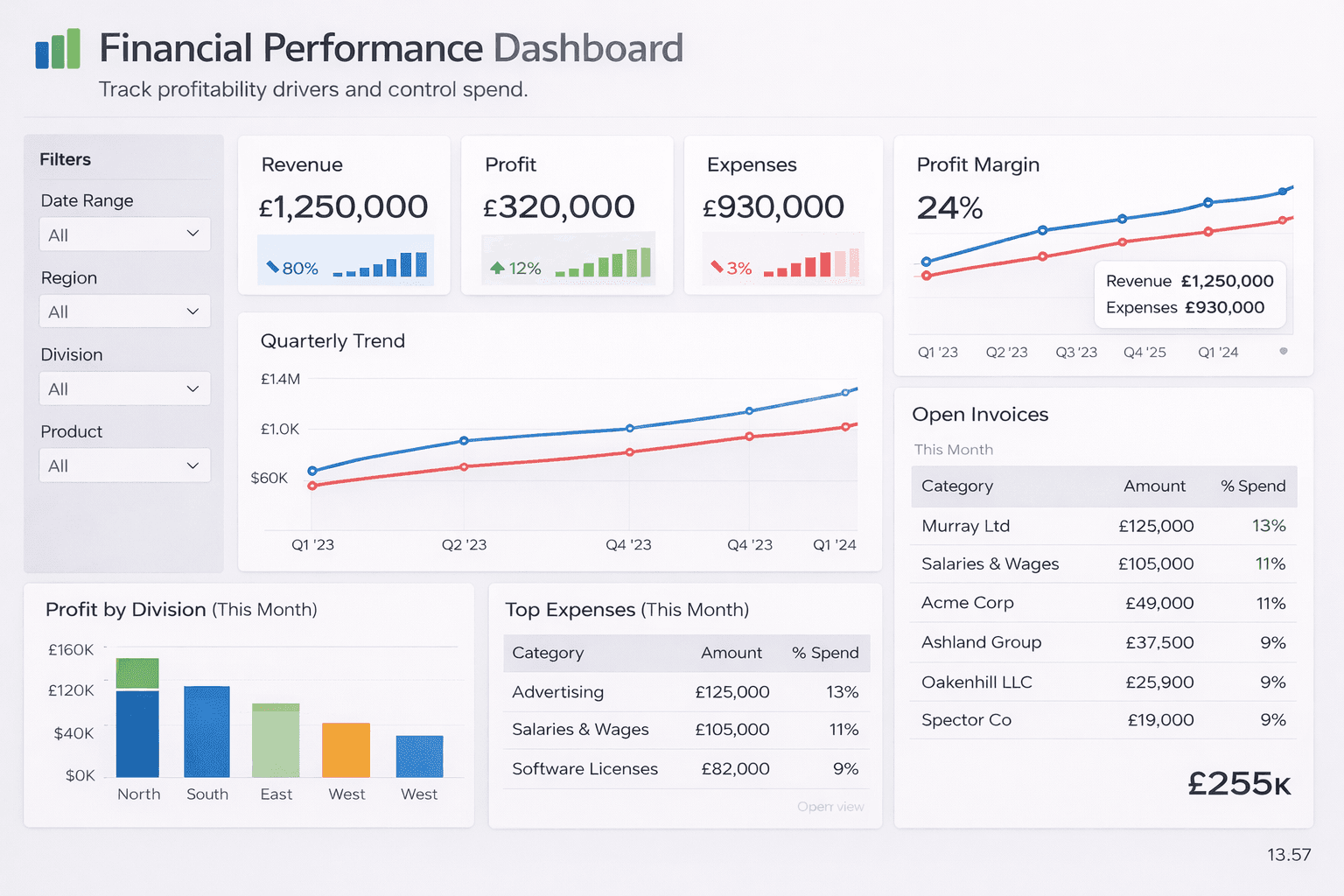
Example Financial Performance Dashboard
Example Financial Performance Dashboard
A Financial Performance Dashboard gives business leaders a clear, real-time view of revenue, costs, margins, and cash flow so they can make faster, more confident decisions. Instead of relying on scattered spreadsheets or delayed month-end reports, it brings all financial metrics into one unified source of truth—making it easy to spot rising expenses, declining margins, or underperforming products before they become expensive problems. By automating data flows and providing accurate forecasts, it helps organisations control spend, protect profitability, and plan growth with precision.
A Financial Performance Dashboard gives business leaders a clear, real-time view of revenue, costs, margins, and cash flow so they can make faster, more confident decisions. Instead of relying on scattered spreadsheets or delayed month-end reports, it brings all financial metrics into one unified source of truth—making it easy to spot rising expenses, declining margins, or underperforming products before they become expensive problems. By automating data flows and providing accurate forecasts, it helps organisations control spend, protect profitability, and plan growth with precision.
Core Financial Data Sources
Core Financial Data Sources
A financial dashboard is only as good as the data behind it. High-quality financial dashboards bring together information from multiple systems to create a single, trusted view of financial performance, cash flow, and risk.
A financial dashboard is only as good as the data behind it. High-quality financial dashboards bring together information from multiple systems to create a single, trusted view of financial performance, cash flow, and risk.
Accounting & General Ledger Systems
Accounting & General Ledger Systems
These systems form the core financial source of truth.
These systems form the core financial source of truth.
Typical data:
Revenue and expense transactions
Chart of accounts
Journals and adjustments
Balance sheet and P&L data
Typical data:
Revenue and expense transactions
Chart of accounts
Journals and adjustments
Balance sheet and P&L data
Common platforms:
Xero
QuickBooks
Sage
NetSuite
SAP / Oracle Financials
Common platforms:
Xero
QuickBooks
Sage
NetSuite
SAP / Oracle Financials
Dashboard use cases:
Profit & loss tracking
Cost structure analysis
Margin monitoring
Period-over-period comparisons
Dashboard use cases:
Profit & loss tracking
Cost structure analysis
Margin monitoring
Period-over-period comparisons
Banking & Cash Management Systems
Banking & Cash Management Systems
Used to understand liquidity and cash flow in real time.
Used to understand liquidity and cash flow in real time.
Typical data:
Bank balances
Inflows and outflows
Transaction categorisation
Payment timings
Typical data:
Bank balances
Inflows and outflows
Transaction categorisation
Payment timings
Common sources:
Open Banking APIs
Bank feeds (Barclays, HSBC, Lloyds, etc.)
Treasury management tools
Common sources:
Open Banking APIs
Bank feeds (Barclays, HSBC, Lloyds, etc.)
Treasury management tools
Dashboard use cases:
Cash runway tracking
Cash flow forecasting
Working capital visibility
Dashboard use cases:
Cash runway tracking
Cash flow forecasting
Working capital visibility
Billing, Invoicing & Subscription Platforms
Billing, Invoicing & Subscription Platforms
Critical for understanding earned vs. billed vs. collected revenue.
Critical for understanding earned vs. billed vs. collected revenue.
Typical data:
Invoices issued and paid
Accounts receivable aging
Subscription plans and renewals
Deferred and recurring revenue
Typical data:
Invoices issued and paid
Accounts receivable aging
Subscription plans and renewals
Deferred and recurring revenue
Common platforms:
Stripe
Chargebee
Zuora
Recurly
In-house billing systems
Common platforms:
Stripe
Chargebee
Zuora
Recurly
In-house billing systems
Dashboard use cases:
Revenue recognition
AR aging and collections risk
Monthly recurring revenue (MRR)
Churn and retention analysis
Dashboard use cases:
Revenue recognition
AR aging and collections risk
Monthly recurring revenue (MRR)
Churn and retention analysis
Sales & CRM Systems
Sales & CRM Systems
Finance rarely exists in isolation from sales. CRMs provide forward-looking financial signals.
Finance rarely exists in isolation from sales. CRMs provide forward-looking financial signals.
Typical data:
Pipeline value
Forecasted revenue
Deal close dates
Win/loss outcomes
Typical data:
Pipeline value
Forecasted revenue
Deal close dates
Win/loss outcomes
Common platforms:
Salesforce
HubSpot
Pipedrive
Zoho CRM
Common platforms:
Salesforce
HubSpot
Pipedrive
Zoho CRM
Dashboard use cases:
Revenue forecasting
Bookings vs. revenue analysis
Sales efficiency metrics
Financial planning inputs
Dashboard use cases:
Revenue forecasting
Bookings vs. revenue analysis
Sales efficiency metrics
Financial planning inputs
Expense Management & Procurement Tools
Expense Management & Procurement Tools
Used to control cost leakage and operational spend.
Used to control cost leakage and operational spend.
Typical data:
Employee expenses
Vendor invoices
Purchase orders
Spend categories
Typical data:
Employee expenses
Vendor invoices
Purchase orders
Spend categories
Common platforms:
Expensify
SAP Concur
Coupa
Procurify
Common platforms:
Expensify
SAP Concur
Coupa
Procurify
Dashboard use cases:
Cost control
Budget vs. actuals
Vendor spend concentration
Expense policy compliance
Dashboard use cases:
Cost control
Budget vs. actuals
Vendor spend concentration
Expense policy compliance
Payroll & HR Systems
Payroll & HR Systems
Labour is often the largest operating expense.
Labour is often the largest operating expense.
Typical data:
Salaries and bonuses
Headcount by department
Employer taxes and benefits
Hiring and attrition
Typical data:
Salaries and bonuses
Headcount by department
Employer taxes and benefits
Hiring and attrition
Common platforms:
Gusto
ADP
Deel
BambooHR
Common platforms:
Gusto
ADP
Deel
BambooHR
Dashboard use cases:
Payroll cost tracking
Revenue per employee
Departmental cost allocation
Workforce planning
Dashboard use cases:
Payroll cost tracking
Revenue per employee
Departmental cost allocation
Workforce planning
Planning, Budgeting & Forecasting Tools
Planning, Budgeting & Forecasting Tools
These systems support forward-looking financial decisions.
These systems support forward-looking financial decisions.
Typical data:
Budgets and forecasts
Scenario assumptions
Variance calculations
Typical data:
Budgets and forecasts
Scenario assumptions
Variance calculations
Common platforms:
Anaplan
Adaptive Planning
Google Sheets / Excel (structured)
Common platforms:
Anaplan
Adaptive Planning
Google Sheets / Excel (structured)
Dashboard use cases:
Budget vs. actual analysis
Scenario modelling
Financial forecasting accuracy
Dashboard use cases:
Budget vs. actual analysis
Scenario modelling
Financial forecasting accuracy
Bringing It All Together
Bringing It All Together
High-performing financial dashboards typically centralise these sources into a data warehouse, apply consistent business logic, and surface insights through BI tools such as Power BI, Tableau, or Looker.
The result:
One version of the truth
Faster close cycles
Better forecasting accuracy
Finance teams that drive decisions, not just reports
© 2025 Neo Analytica. All rights reserved.